
Molecular organization of the Chlorella sorokiniana pyrenoid
Published in bioRxiv (preprint), 2026
Abstract
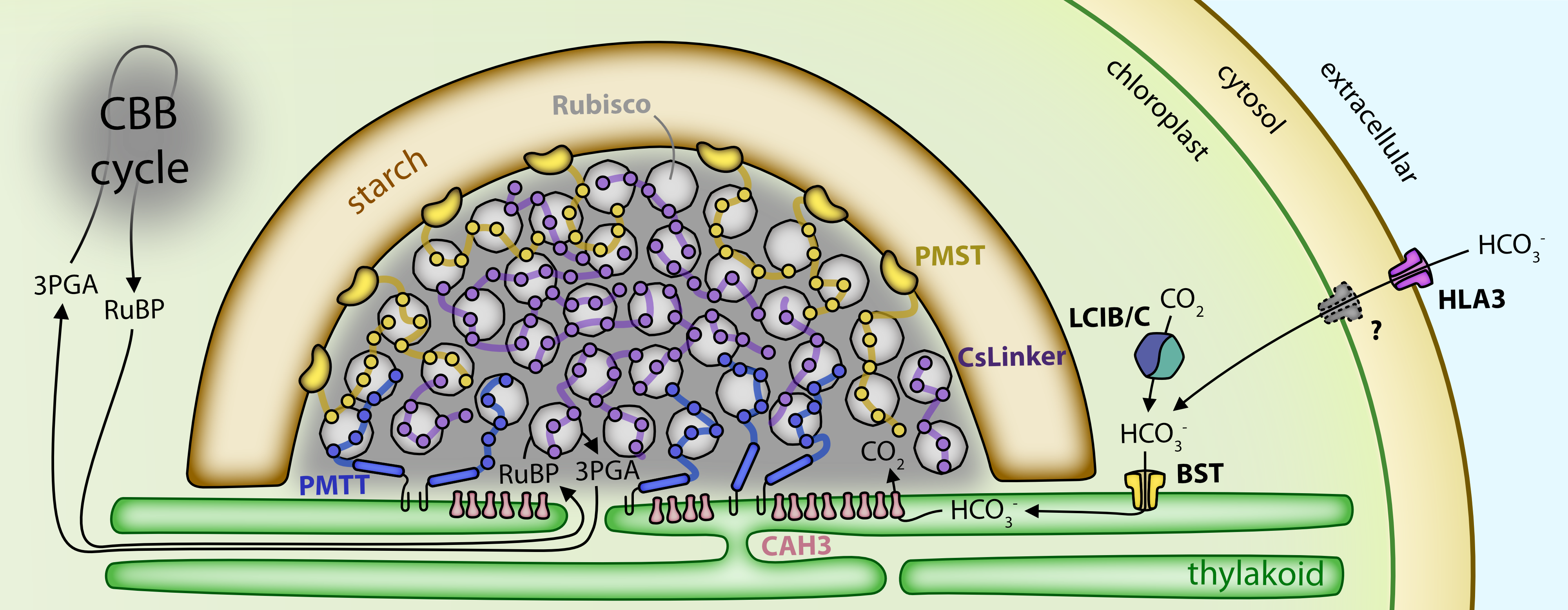
Algae operate CO2-concentrating mechanisms (CCMs) that deliver concentrated CO2 to Rubisco packaged within a specialized microcompartment called a pyrenoid. Pyrenoids are globally important biomolecular condensates, but their convergent evolution means that molecular composition and architecture cannot be inferred across clades. Here we characterize the pyrenoid of the trebouxiophyte alga Chlorella sorokiniana. Using cryo-electron tomography, we provide an architectural overview of the pyrenoid and visualize pyrenoid-specific protein complexes. Quantitative proteomics and Rubisco co-immunoprecipitation coupled to mass spectrometry demonstrate that inorganic carbon delivery machinery is conserved across green algae, but pyrenoid structural components are not. In vitro reconstitution supports the role of two previously undescribed proteins: one in assembly of pyrenoid-traversing thylakoids (putative matrix-thylakoid tether; PMTT) and another in tethering starch to the Rubisco matrix (putative matrix-starch tether; PMST). In Nicotiana benthamiana, PMTT localizes to the thylakoid stromal lamellae and PMST to chloroplast starch granules. Our findings provide insight into the molecular logic of pyrenoid assembly, how proteins mediate condensate-membrane and condensate-starch interactions, and expand the pyrenoid engineering toolkit for plants.
Description
This study is a direct follow-on from our 2024 Nature Plants paper identifying the Chlorella Rubisco-condensing linker (CsLinker). Here we set out to build a full molecular and architectural picture of the Chlorella pyrenoid, using cryo-electron tomography (cryo-ET) to resolve its native ultrastructure and comparative proteomics/co-immunoprecipitation to identify its protein components.
Cryo-ET revealed a pyrenoid architecture clearly distinct from Chlamydomonas: rather than multiple tubules converging into a reticulated knot, Chlorella has a single pair of appressed pyrenoid-traversing thylakoids (PTTs) that bisect the Rubisco matrix, with small membrane fenestrations connecting the matrix to the surrounding stroma, and a previously undescribed braided membrane morphology along the PTTs. Subtomogram averaging identified a square-lattice protein array on the matrix-facing PTT membrane, consistent in size with the carbonic anhydrase CsCAH3.
Using the Rubisco-binding motif (RBM) of CsLinker as a search query, we identified three further RBM-containing proteins that co-immunoprecipitate with Rubisco: PMTT (a transmembrane protein that localizes to the PTTs and binds thylakoid lipids in vitro, particularly MGDG and SQDG), PMST (a CBM20 starch-binding protein that recruits Rubisco-CsLinker condensates onto starch granules), and RHOP (a rhodanese-domain matrix protein). All three can drive phase separation of Chlorella Rubisco in vitro, though only CsLinker reaches concentrations sufficient to do so efficiently on its own at physiological ratios — PMTT, PMST and RHOP instead appear to be recruited into pre-formed CsLinker-Rubisco condensates. Heterologous expression in Chlamydomonas and Nicotiana benthamiana confirmed domain-appropriate localization (PMTT to thylakoid membranes, PMST to starch), though neither protein could functionally complement the corresponding Chlamydomonas mith1 or saga1 mutants, indicating that despite superficially analogous roles, the two lineages have arrived at pyrenoid assembly through non-interchangeable, convergently evolved solutions. Together with our Ulva and Chlorella-linker work, this further expands the molecular toolkit available for engineering a pyrenoid-based CCM into C3 crop plants.
Cite: Naduthodi, M.I.S., Barrett, J., Pritchard, J. et al. "Molecular organization of the Chlorella sorokiniana pyrenoid." bioRxiv (2026). doi: 10.64898/2026.07.17.739135 https://www.biorxiv.org/content/10.64898/2026.07.17.739135v1.full