
A spatial atlas of the seaweed CO2-fixation machinery reveals a unique Rubisco condensation mechanism
Published in bioRxiv (preprint), 2026
Abstract
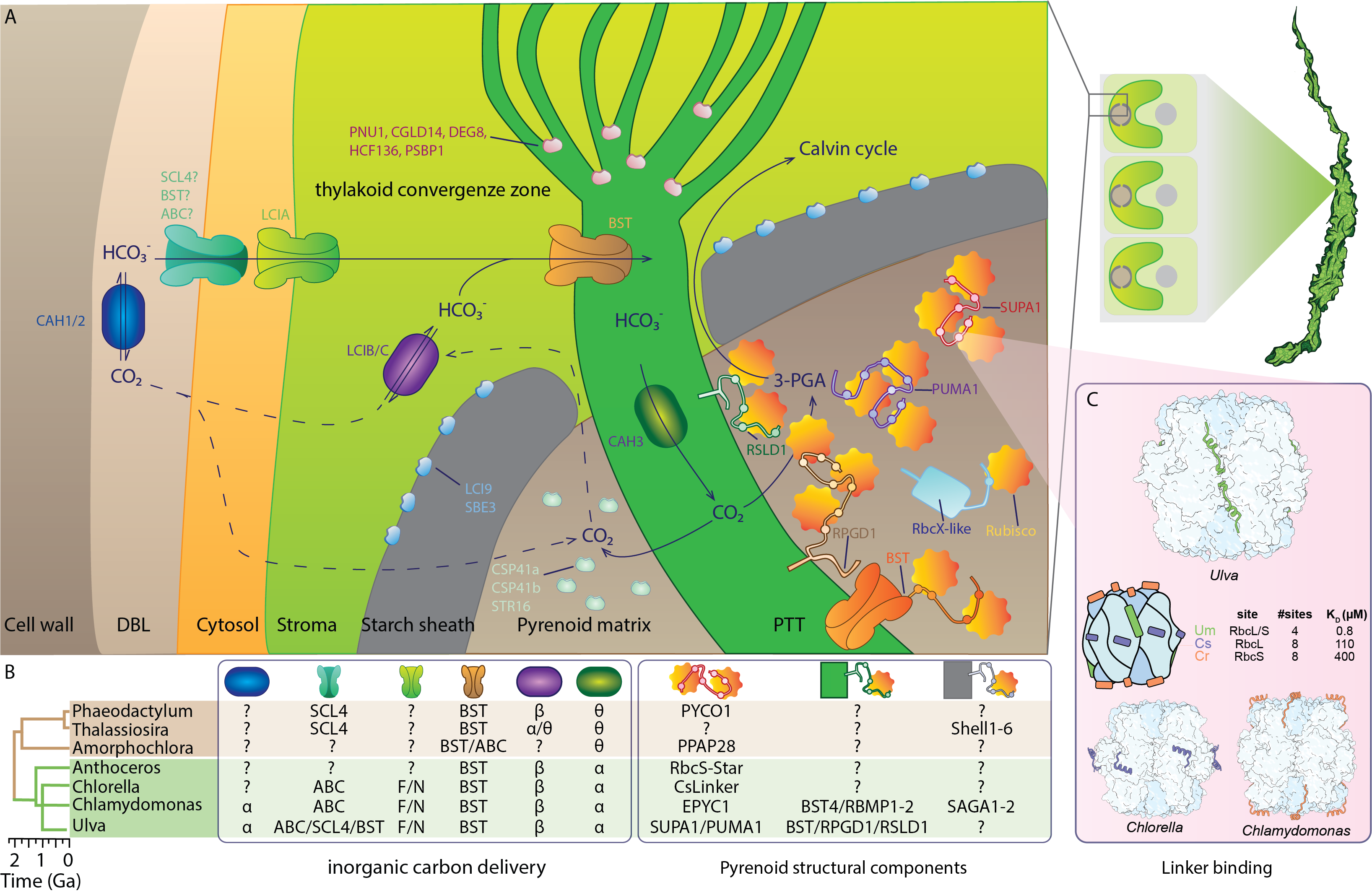
Seaweeds (macroalgae) are major primary producers in coastal ecosystems, yet the molecular machinery underlying their CO2-concentrating mechanism (CCM) has remained undescribed. We fluorescently tagged 201 proteins associated with CO2 acquisition in the green seaweed Ulva (sea lettuce), assigning 68 to distinct pyrenoid subdomains. We identify Seaweed Ulva Pyrenoid Assembly 1 (SUPA1) as the core pyrenoid assembly factor and show that it condenses Rubisco via a previously undescribed mechanism: a disorder-to-helix transition upon binding, combined with steric occlusion that limits occupancy to four of the eight available Rubisco binding sites. This work provides the first large-scale spatial protein map of carbon fixation in a multicellular seaweed and reveals a mechanistically distinct route to pyrenoid-based Rubisco condensation within the green lineage.
Description
While pyrenoid-based CCMs have now been characterised at the molecular level in the unicellular model Chlamydomonas reinhardtii and, more recently, in the trebouxiophyte Chlorella and in hornworts, no molecular data existed for any multicellular seaweed prior to this study. Using recently developed genetic tools in Ulva compressa/mutabilis, we carried out a large-scale fluorescent protein-tagging screen, localising 160 of 201 tagged candidates and assigning 68 proteins to pyrenoid subdomains (matrix, periphery or the pyrenoid-traversing thylakoid). Strikingly, none of the core structural components that build the Chlamydomonas pyrenoid — including the Rubisco-condensing linker EPYC1 — have identifiable orthologues in Ulva, indicating that seaweed pyrenoid assembly has evolved independently.
Using our sequence-independent linker-identification pipeline, FLIPPer (originally developed for the Chlorella linker discovery described in our 2024 Nature Plants paper), we identified SUPA1 as the Ulva Rubisco-condensing protein. Cryo-EM, ITC and native mass spectrometry reveal that a single SUPA1 repeat binds across two Rubisco large subunits and one small subunit, undergoing a folding-upon-binding transition to form a short α-helix that was unstructured in isolation. Geometric clashes between adjacent binding sites limit simultaneous occupancy to four of the eight sites available on the Rubisco holoenzyme — a binding mode distinct from both the RbcS-binding EPYC1 (Chlamydomonas) and the RbcL-binding CsLinker (Chlorella), and compensated for by roughly 100-fold higher binding affinity. Together with CRISPR knockouts confirming SUPA1 is required for Rubisco condensation into the pyrenoid, and comparative analysis across the three characterised linker systems, this work extends our understanding of how eukaryotic CO2-concentrating mechanisms have convergently evolved across the green lineage, and establishes Ulva as a tractable multicellular model for pyrenoid engineering.
Cite: Barrett, J., Dégut, C., Sebiani Calvo, A. et al. "A spatial atlas of the seaweed CO2-fixation machinery reveals a unique Rubisco condensation mechanism." bioRxiv (2026). doi: 10.64898/2026.07.16.738900 https://www.biorxiv.org/content/10.64898/2026.07.16.738900v1.full